Discover how Heinen Delfts Blauw created a “home” for product data to scale globally. Learn how centralization improves workflows, reduces manual work, and enables faster multi-channel growth.
At this year’s Webwinkel Vakdagen, we hosted a keynote together with Heinen Delfts Blauw, Dutch heritage brand known for its craftsmanship and iconic Delfts Blauw products.
During the session, Frans Jansen (Operational Director) and Martijn Leenen (E-commerce Specialist) shared how the company is transforming from a traditional, craft-driven business into a modern, internationally scaling ecommerce organization.
Their story covered much more than brand positioning or channel growth. It focused on what happens behind the scenes when a company starts to scale rapidly — and where things begin to break.
As Heinen Delfts Blauw expanded across:
they encountered a challenge that many growing businesses will recognize:
managing product data across teams, tools, and channels.
What made this keynote particularly relevant is that it did not stay at a strategic level. Frans and Martijn provided a practical look at how product data became a bottleneck for growth — and how centralizing and structuring that data enabled the company to move faster, reduce manual work, and prepare for future requirements.
This article breaks down the key insights from their presentation and translates them into practical lessons for ecommerce teams dealing with similar challenges.
Heinen Delfts Blauw operates with a clear mission: preserving the Delfts Blauw craft while making it relevant for modern interiors.
At the same time, the company is focused on growth. This includes strengthening brand awareness, expanding into Home & Living, improving the customer journey, and increasing its presence across ecommerce, marketplaces, and retail.
Like many growing businesses, they are investing in multiple areas at once:
This combination of ambitions introduces complexity, particularly when it comes to managing product information.
Growth does not only create opportunity — it exposes weaknesses in your foundation.
During the keynote, the challenge was clearly defined across three dimensions: teams, tools, and channels.
Product data is not owned by a single department. It is created and used by multiple teams, including production, marketing, ecommerce, and sales. Each team contributes specific information, such as product specifications, descriptions, or channel requirements.
Without clear ownership, this leads to fragmentation.
Everyone contributes, but no one owns the full picture.
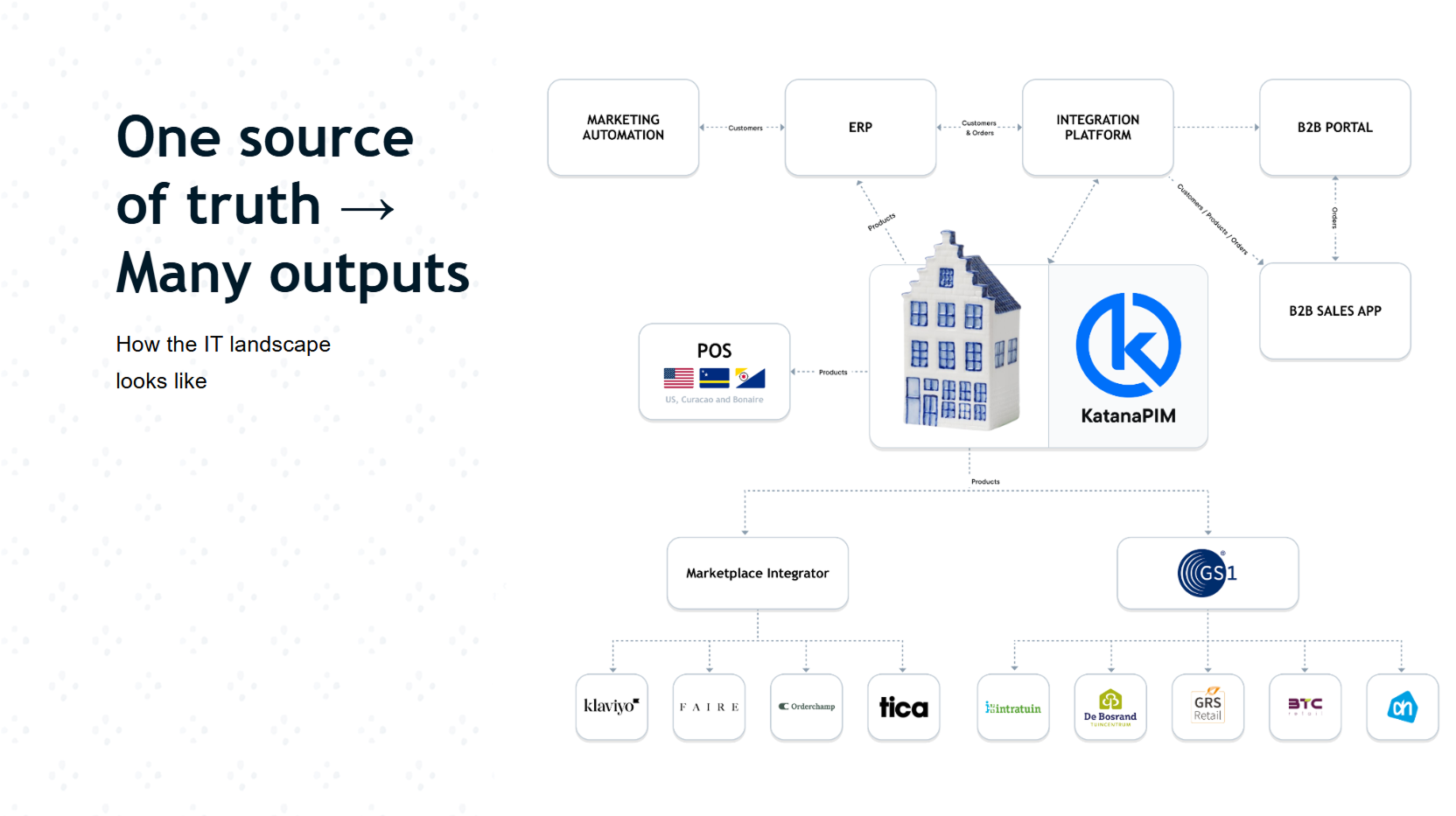
As the organization grows, so does the number of systems involved. ERP systems, webshops, marketplace integrations, and POS systems all require access to product data.
Without a central structure, each system can become a separate source of truth.
Every tool becomes its own version of the truth.
Each sales channel has its own requirements. Marketplaces, retail partners, GS1 data pools, and internal systems all expect different formats and levels of detail.
When this is handled manually:
complexity turns into duplication, and duplication turns into errors.
The result is not just messy data — it directly impacts operations.
Common consequences include:
As highlighted during the presentation:
Product data is the “blood of the organization”.
If the data is not structured, the entire organization slows down.
To address these challenges, Heinen Delfts Blauw made a fundamental change:
they centralized all product data into one shared environment.
This created a single source of truth that:
Centralization is not just about storage: it is about structure and control.
Centralizing product data only works if processes change as well.
They defined what “complete” means per channel.
Completeness is not universal, it depends on where you sell.
Each team owns its part of the data:
Clear ownership removes friction.
Instead of fixing issues at launch:
Workflows prevent problems instead of fixing them later.
Automation only works when the foundation is stable.
Otherwise, you scale errors instead of solving them.
With a centralized structure in place:
One source of truth enables scalable distribution.
The impact was immediate:
This is what scalable product data looks like in practice.
From the keynote:
Many businesses face the same challenges:
The difference is in how they respond.
Heinen Delfts Blauw did not scale their chaos — they fixed their foundation.
This keynote shows that product data is not just operational.
It is a strategic asset.
By centralizing product data, defining ownership, and structuring workflows, Heinen Delfts Blauw created a foundation that supports both current operations and future growth.
For companies looking to scale, the lesson is clear:
growth requires structure — and that structure starts with product data.


Entdecken Sie, wie KatanaPIM Ihnen dabei hilft, Ihre Online-Präsenz auszubauen.

Beginnen Sie kostenlos mit PIM zu arbeiten